by Vand Magazine Editorial Team
There is a Japanese art form called Kintsugi, the practice of repairing shattered ceramics with gold lacquer, transforming fractures into luminous seams. The broken object does not pretend it was never damaged. Instead, it declares: I have been broken, and I am more beautiful for it.
This is the philosophy aim/aimme brings to Vancouver Fashion Week FW26.
Founded as a photo studio in Hokkaido, aim/aimme began not with fashion, but with memory. Their original purpose was to capture life’s ceremonial milestones like coming-of-age celebrations, weddings, family portraits, the moments when identity is formally declared. But somewhere between the lens and the subject, they realized something: the garments were not merely costumes. They were catalysts for emotion.
Vand: aim/aimme started as a photo studio. How did capturing traditional milestones translate into designing runway fashion?
aim/aimme: What we value most is leaving behind photographs that allow people to recall the emotions they felt during the experience of being photographed. To achieve this, special garments that make the heart dance were absolutely essential. We want people to enjoy coordinating in a more fashionable way. It’s no exaggeration to say that our original garments were born out of necessity.
Editor’s Note: Tokimeku (ときめく) – The Untranslatable Flutter
The word tokimeku appears repeatedly in aim/aimme’s responses. It means “to flutter,” “to throb,” “to make the heart race” but it carries a specificity that English lacks. It is not mere excitement; it is the physical sensation of joy rising in the chest. For aim/aimme, a garment’s primary function is not aesthetic, it is emotional. If it does not make the heart tokimeku, it has failed.
When asked if they design with the “final photograph” in mind, their answer is revealing: “What we keep in mind when designing is ‘Does this make my heart truly feel kawaii?’ and ‘Is this a garment that makes the heart flutter?’ Of course, we are conscious of how it will look in photographs. But that comes at the final stage. First and foremost, we prioritize whether the heart flutters when you put your arms through the sleeves.”
Vand: You work extensively with traditional ceremonial wear like Furisode and Hakama. How do you balance strict traditional rules with contemporary innovation?
aim/aimme: Each Japanese tradition carries its own meaning. I believe it is essential to first understand that meaning and hold respect for it.
その上で、今の私たちの感性をのせて、未来に繋いでいけるように意識しています。
“On that foundation, we layer our contemporary sensibility, the sensibility of those of us living in the present, and we are conscious of connecting it to the future.”
This is not fusion. This is succession. aim/aimme does not treat tradition as a museum artifact to be preserved under glass. They treat it as a living language, one that must be spoken by each generation in their own dialect, or it will die.
Operating a studio in Harajuku, known as the global epicenter of kawaii culture, gives them a unique vantage point. “Harajuku is a city that embodies the universal language of ‘Kawaii,'” they explain. “Perhaps it is precisely because we witness the latest culture before our eyes that we can see traditional beauty and formality anew. While maintaining a bird’s-eye perspective, we incorporate the essence of both into our designs.”
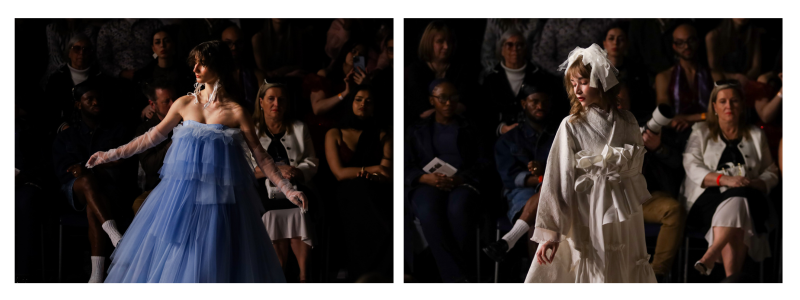
Vand: Your team includes photographers, makeup artists, designers, and counselors. How does this multidisciplinary approach change garment creation?
aim/aimme: By having professionals from each field together, we can make the multiplicity of perspectives our strength. Counselors are closest to customers on a daily basis, so they understand the real sensibilities of our clients. Hair and makeup artists and photographers possess creative perspectives with top-level visual insight. By adding the designer’s perspective to this, we can create designs from multiple viewpoints, not just one. That is our strength.
Here, aim/aimme reveals something radical: they design not from the designer’s ego, but from the wearer’s need. The counselor, the person who listens to a bride’s anxieties, a young woman’s hopes for her coming-of-age ceremony, holds equal creative authority to the designer. Identity, in this model, is not imposed. It is co-created.
When asked about a specific detail inspired by this collaborative process, they note: “One thing that surprised us during the production of this show was that, across all job roles, the image we were aiming for was remarkably similar. For this show, we solicited design image ideas from all employees. Even so, the major direction remained largely unchanged, and the destination of what each person considered ‘kawaii’ was the same.”
Vand: When the international audience sees your presentation, what message do you hope they take away about Japanese craftsmanship?
aim/aimme: We want to connect Japanese traditional techniques and sensibility to the future. In an age where AI and machines are advancing, we felt a desire to protect the precious techniques born from the handwork of artisans, one piece at a time.
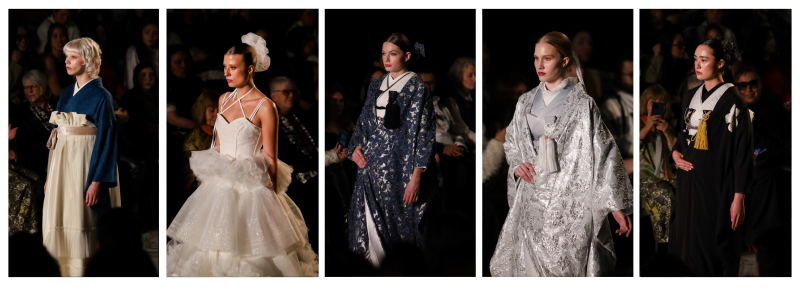
The “Kintsugi” garment incorporated into the final piece features patterns hand-drawn by designers, with gold leaf entirely applied by hand by artisans.
金継ぎは、壊れたものを修復して、新しいものとして美しく読みがえらせるものです。
“Kintsugi is the practice of repairing broken things and beautifully reviving them as something new.”
この感覚こそ、私たちの今回目指すビジョンに近いと考え、作成をしました。
“We felt this sensibility was close to the vision we aimed for this time.”
I feel it achieved a delicate yet powerful finish that machines cannot produce. To pass down this delicate work to future generations, I would be delighted if people could feel the artisans’ delicate skill and passion through this show.
In an era of AI-generated design and algorithmic trend forecasting, aim/aimme offers a counter-narrative: that the human hand, imperfect, slow, irreplaceable, is not a limitation.
The Kintsugi garment is not a metaphor. It is a manifesto. Tradition is not something that must remain intact to remain valuable. It can break. It can be reimagined. And in the seams where old meets new, something golden emerges.
aim/aimme does not ask the international audience to admire Japanese craftsmanship from a distance. They ask us to recognize it as a living practice, one that honors the past by refusing to be trapped in it.
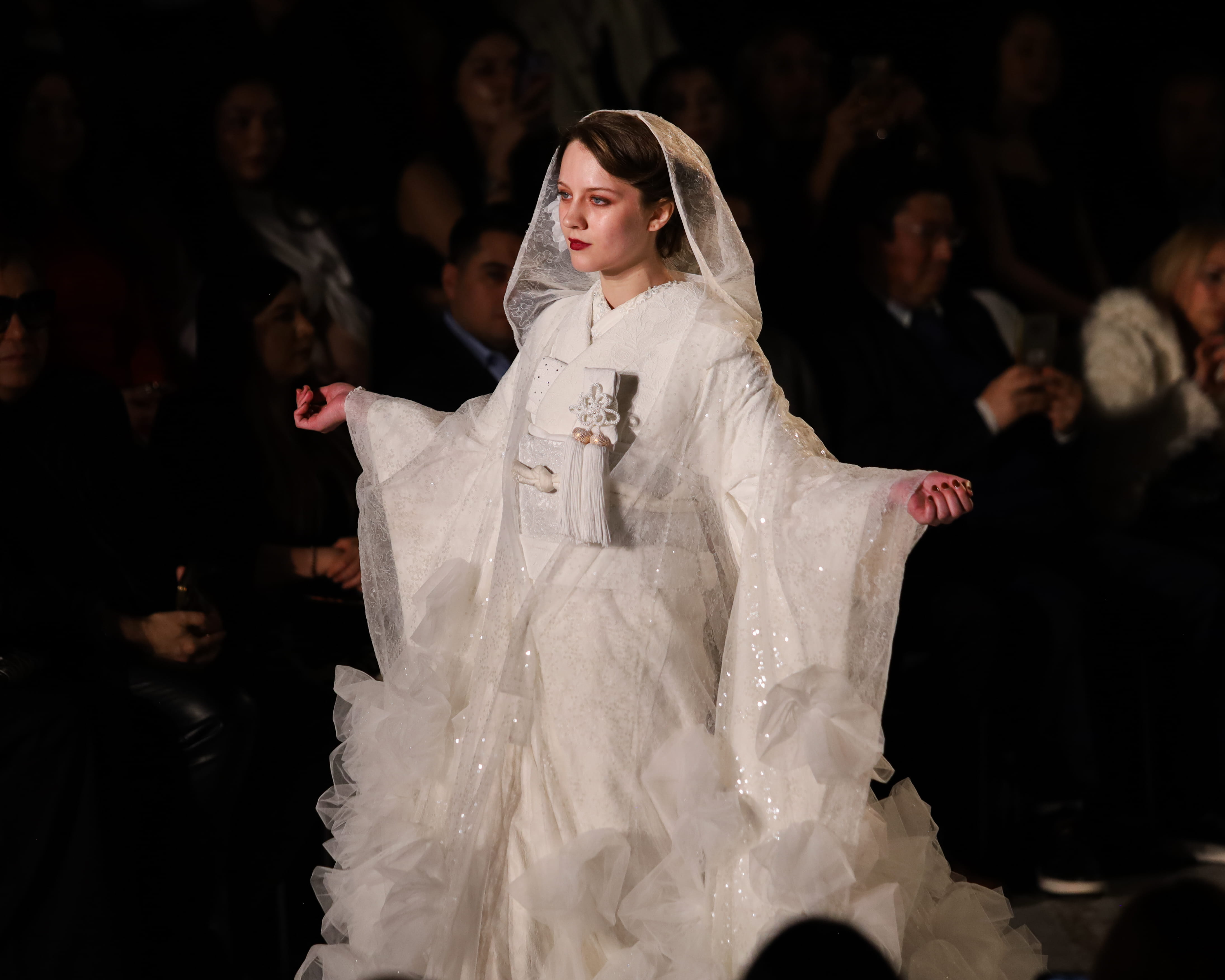
Tokimeku. Let your heart flutter. Let the broken pieces shine.
aim/aimme presents at Vancouver Fashion Week FW26.